Tuesday, April 12, 2011

A great day at Tuthilltown Spirits in New York (picture heavy post)

My wife and I spent the weekend in New York's Hudson Valley, with the goal of seeing some old friends and visiting a few wineries in the area.  We visited Robibero Vinyeards, then Whitecliff Vineyard.  We had a lot of fun, and tasted and bought a lot of wine.

At Whitecliff the conversation turned to whiskey.  That's when we learned we were only a few minutes' drive from Tuthilltown Spirits!  I had never toured a distillery before, so we saddled up and headed out.

We pulled into the driveway and were greeted by a nondescript building, the stainless tank and hand-painted sign the only things giving it away as part of the distillery.

The urge to climb on the tank was almost irresistible, but somehow I managed to control myself.  The sightglass on the side of the tank was a familiar sight from homebrewing.

The first thing we saw when we went inside were mountains of little barrels.  It turns out their main office doubles as the aging room.  These are "baby" barrels, which is where their Baby Bourbon gets its name.  You can also purchase used barrels from them, since by law bourbon may only be called bourbon if it is matured in first-use casks. 

They use the baby barrels because the whiskey matures faster in them - more surface area in contact with the spirit.  I believe our guide mentioned 3 months per gallon.

They also have 1- and 2-liter casks for sale, similar to the ones I already have.

In addition to the various whiskies, bottles, t-shirts and whatnot, they had a neat old copper still on one of the tables.

By now we were chomping at the bit to take the tour!  I thought the tour guide was a little unusual, but maybe they do things differently up there.  We signed up for the tour and tasting, then headed outside to see the distillery, which lives in the barn across the driveway.

Our guide started with a history of the distillery, explaining that they are the first distillery in NY since Prohibition.  That's why their bottles are shaped like apothecary's medicine bottles - during Prohibition, distillers would market their product as medicine, which was legal for sale.

He went on to explain the various bits of equipment they're using, and how much of it was re-purposed from things they found on the farm when they got there.  This is the malt mill they use to grind the grist (grain).

After grinding, the grist is fed into this vessel, which I would call a "mash tun".  It's where the grist is mixed with hot water to convert the starches into sugars that the yeast can eat.  There's all sorts of enzymatic magic going on in there.

He explained the "iodine test" to us, which they use to ensure that the conversion is complete.

Then that liquid and the grain are moved for cooling with this grain pump.  I'm not sure if the liquid is called "wash" at this point or after fermentation.  I found it interesting that the grain is included, and not lautered (separated) as we do in beer making.  Our guide explained that as such a small batch producer, they don't have to worry about burning the grain during distillation like a big producer might.  They also like the flavor profile.

The liquid and grain are moved into this vessel, a re-purposed milk cooler!  Here the mixture cools down to the proper temperature to pitch the yeast.

After that the mixture is pumped into the fermentation room.

The smell of 8 open tanks of fermenting corn mash is delicious and hard to describe.  Our guide explained how the tank on the right is still actively fermenting, with the CO2 being produced by the yeast pushing the corn to the top to make the dark "cap" you can see.

The tank on the left is done fermenting, so the corn has settled to the bottom.

We were invited up onto the step stool to get our noses right up into the tank.  My friend Dan described the smell as if you made corn bread with yeast.

We could see the CO2 "boiling" up out of solution.  It looked like a coarse porridge.

Then it was time to see where distilling really breaks off from brewing.  We headed up the wooden stairs to the stills.  Rounding a corner, their shiny new still loomed large.

Our guide explained that due to demand they just had to install a still twice the size of their old ones.  It required building the extension to the roof you can see in the picture and was just completed a week before we arrived.

This is the view looking towards the old stills.  I really love how such beautiful, elegant equipment is still so utilitarian and almost humble, boiling and condensing liquids and gases.

Our guide explained the entire distillation process, much of which I've already forgotten, of course.  He was very entertaining and took the time to answer all of our questions.

He explained how the whiskey is distilled twice, first in this still and second in the still behind him.

The distiller uses a hydrometer and his palate to determine when the whiskey is ready for the various steps it goes through.

This doodad with all the portholes is used to cause the different alcohols that boil at different temperatures to condense so they can be separated from one another.

He explained how the first alcohols that come out are the "heads".  It's basically wood alcohol, or acetone.  They do not use that at all.

Next come the "hearts".  That's the good ethanol they want for their whiskey.  This is taken off into stainless drums to later be put into oak casks.

The last are the "tails".  The tails are not used in the final distillation, but are saved in the wicker-covered demijohns in the last picture.  They then add some of the tails to the next batch, which helps flavor the batch and extracts some more of the good alcohols left.

Speaking of good alcohols, he opened a drum of recently-distilled spirit for us to smell.  The alcohol odor was overwhelming, but when I smelled with an open mouth I could taste the whiskey.  It was a really cool experience.

One more shot of the new still setup.  Shiny!


Then finally it was time to taste!  The tour comes with a tasting of any 3 of their offerings - which include a rum and two vodkas!

As I have already had their Manhattan Rye, I opted to taste the two bourbons - Baby Bourbon and 4-Grain Bourbon - and the single malt.  The 4-grain is made from 51% corn, with the rest being barley, wheat and rye.

As you can see, the selections were delicious, and more than one followed me home.  They also had a bourbon-cask-aged maple syrup, which was out of this world and found its way into my bag.

I will be aging the clear corn whiskey in one of my barrels.  I haven't decided if it'll go into the rye or barley yet.

With Tuthilltown less than two hours' drive from my home, I see more visits in my future.  We had a great time and I would even do the tour again.  I look forward to seeing the changes in the distillery as they grow, which they are doing fast!

Friday, March 25, 2011

Laprhoaigian updates from the podcast!

I recently posted our podcast to the Laphroaig USA Facebook page.  Not a fan yet?  Why not?  Go do it.  Go ahead, I'll wait.

Welcome back.  If you listened to the podcast, you heard me say I didn't know a few things.  Laphroaig's USA Ambassador, Mr. Brooking himself, was kind enough to contact me and explain some of the things I didn't know, or didn't have quite right.

I can't say enough how much I appreciate him taking the time to do that.  It makes one feel like a true Friend of Laphroaig, and not just a dollar sign.  He even thanked me for representing their product, which truly made my day!

On to the information.  Some of this may not make much sense if you didn't listen to the podcast, so here is a link if you missed it.  Episode 16.

There were a lot of questions on barrels I couldn't answer.  Laphroaig only uses their barrels once.  Those barrels are used American bourbon barrels.  When they receive the barrels, they undergo a "de-char/re-char" process.  They scrape the char out of the barrels and re-fire them to reinvigorate the oils in the wood.

After they're done, they sell the barrels to the whisky blenders.  When the blenders are done, they'll sell the barrels to grain whisky producers.

Yeast was a big question.  I never hear it talked about.  Simon tells me Laphroaig has one of the longest fermentation times in the industry - up to 90 hours.  They use a Mauri brewer's yeast and let it ferment out to completion.  Anywhere from 45 to 90 hours.

I did make one real mistake: the Laphroaig Quarter Cask's whiskies are from 5 to 11 years old, not 3 and up as I said.  Also, the bourbon barrels are 200 liters, not 200 gallons.  The quarter casks are 100 liters.  Why not 50?  Because a quarter cask is a quarter of a 500 liter sherry butt.

Simon pointed out that peat is not specifically used as a flavoring agent.  The burning peat is used to start the drying process of the malted barley.  After 15-18 hours of using peat, they switch to force-blown air using the residual heat from the stills.  They dry the barley to 2% moisture content.

He also told me about a smoke-bomb, which I can't wait to try: like an Irish car bomb, but drop a shot of Laphroaig into a glass of oatmeal stout.  I just happen to have some oatmeal stout on tap right now...

So thanks again to Simon Brooking and Laphroaig.  I look forward to more products and tastings in the future!  Slainte!

Tuesday, March 22, 2011

Whiskey podcast in the books

The episode was a lot of fun to record.  My Scottish accent is awful, but the episode was a lot of fun and very educational.

Click here to check it out and let me know what you think!  Episode 16 in the archives.

Saturday, March 19, 2011

Talking about whisky on a beer podcast tonight!

I really wanted to get this out earlier, but you know what they said about the best laid plans...

Tonight, 3/19 starting at 8PM EST, we will be broadcasting Final Gravity Podcast live, including a video feed.

I'll be talking about whisky, and I'm sure we'll make at least some effort to tie it into beer.

So please join us!  We love audience participation.  Check out the UStream broadcast here.

Wednesday, March 9, 2011

Come out, come out, wherever you are!

As I sit here sipping a dram of Laphroaig 18, I realize just how long it's been since I've made a post!  I started a new job in February.  My hours have been longer and I've had a lot less free time.

I am planning to attend another tasting in Hoboken on March 22nd.  It is once again given by Simon Brooking, but this time he's representing Ardmore.  I was fortunate enough to sample one of their offerings at the last tasting, and it was good enough that I brought a bottle home with me.

So what do I talk about?  I would love to hear your suggestions on things you'd like to discuss.

I'll answer one question: how do I decide what to buy when I go into a liquor store?  I start by looking at whiskies I've never had before.  After that, I usually spend an inordinate amount of time trying to decide what I feel like trying.  Being familiar with the various regions helps here.  I know what to expect from an Islay, or a Speyside.

Price is always a consideration, of course.  However, I don't worry about it too much.  A bottle of whisky will last me several months, and the difference between a $40 and an $80 bottle isn't really much amortized over a few months.

But even if you don't know a Lowland from a Highland, be adventurous.  Try the one with the label you like best.  It's always worked for me!

Friday, February 11, 2011

A night out with Laphroaig, Ardmore and more

Apologies for the enormo-post-of-doom.  For a two-hour event, there were an awful lot of goings-on.

As a loyal Friend of Laphroaig, I receive email updates about events.  A few weeks ago an email came in about an event at the Turtle Club in Hoboken, NJ.  $40 for dinner and a tasting?  Yes, please!

Myself and two friends took the train into Hoboken and walked over to the Turtle Club, enjoying the brisk night air...who am I kidding, it was $@#%ing cold.  The walk was fun, though, as I had dormed at Stevens Tech in Hoboken in 1994, so it was a wee trip down memory lane for me.

We finally arrived at the Turtle Club, and after choosing the wrong door twice entered into a warm and bustling bar.  A few minutes later we were escorted into the back room where tables were waiting for us.  That, dear friends, is my idea of a warm welcome.  Each setting had three glasses of whisky, a pen, cigar and Laphroaig matches.


There were tubes of whisky scattered about, as well as a pair of Wellies, a wee cask and hunk of peat.  If you don't know why the Wellies are significant, check out the Friends of Lahproaig page.


Simon Brooking, the Laphroaig Master Ambassador, made it a point to introduce himself to all of us and get our names.  He also patiently mugged for photos with us.


After an introduction by Josh Ratner of Allied Beverage, and thanks to Corey and Dave from the Turtle Club, we got down to business.

Josh explained that we would start in Speyside, whose whiskies are generally "for the American palate."  Easy drinking and fairly mild, you probably know a lot of them - Glenlivet, Glenfiddich, The Macallan.  We started with the whisky on the left, Glenrothes.

We were instructed to nose the whisky with our mouths open - this helps get past the alcohol and gives you more of the aromas of the whisky itself.  Also tasting the whisky farther back in the mouth bypasses the front of your tongue giving you less heat and more flavor.  Try it, you may be surprised.  Josh then suggested we add a few drops of water to the whisky using our straws.

This brought up the inevitable question about whether it's a sin to add water to Scotch.  You may remember me discussing this in a previous blog post.  Josh deferred to Simon, who echoed my sentiments - water being bad for Scotch is one of the biggest misconceptions out there.

While we were sipping, a cheese plate came out.  The fragrance of well-aged cheeses was unmistakable.  Gouda, Gruyere, Vermont cheddar, Asiago and Roquefort were all delicious.  I'd love to show you a picture, but...


With that, we moved on to the second whisky - The Glenlivet 15.  Strikingly different to the Glenrothes, yet still distinctly Speyside.  Smooth, just a little sweet.

Then came the grand finale of our first flight - The Glenlivet Nadurra cask strength.  This one really blew us away.  Even at cask strength it was smooth and easy to drink.

As the plates were cleared and the next round of whisky served, Simon sang to us, then talked a bit more about whisky.  I was amused that he is trying to achieve "peace through whisky, one dram at a time!"

I found his talk on blended whiskies especially interesting.  He noted that 70% of a blended whisky is neutral grain alcohol - even the very expensive Johnny Walker Blue.

Then it was time to taste our next selection - Ardmore 5 year, which contains whiskies aged from 5-13 years.  A lovely and surprisingly refined whisky for such a young'un.

Simon started talking about peat and smoke.  While explaining to us that every inch of peat represents 100 years of decomposition, he lit a chunk of it with a butane torch and walked around the room.  The delicious smell of peat smoke filled the air.


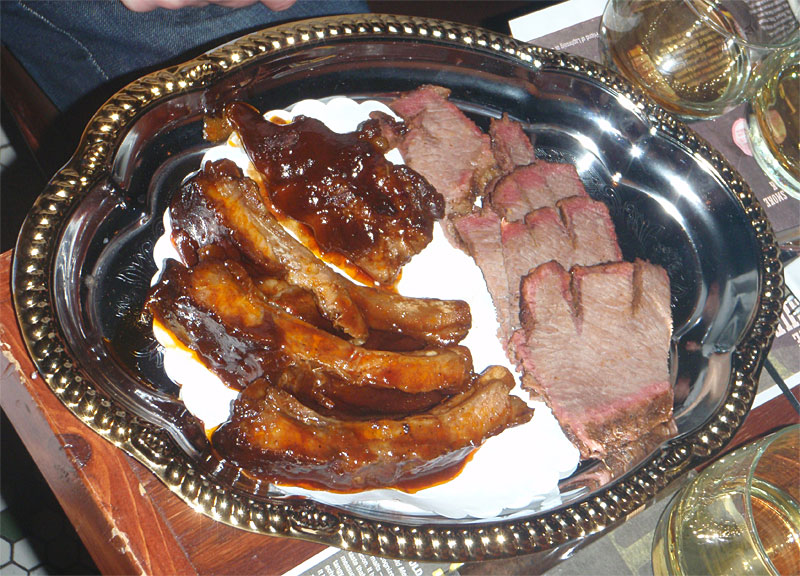
It was about here that the entree appeared.  Pulled-pork sliders with cole slaw, ribs and brisket, all smoked that morning by chef Carlos, using peat from Laphroaig that Simon had brought with him.  To call the food delicious would be a vast understatement.  You can see we tucked in with vigor...


We moved on to taste the Laphroaig 10-year, the whisky most of us think of when we hear Laphroaig.  It distinctive peat smoke nose is always a treat, but Simon showed us a new way to enjoy it.  We wet our palms with the whisky, then rubbed them briskly together.  The smells that burst from our hands were nothing short of amazing.  Definitely give this a try at home.

We moved on to Laphroaig Quarter Cask, one of my personal favorites.  It has the peaty backbone of Laphroaig, with the added character of wood from extra maturing in smaller barrels.  Look for a review on it later.


Then, sadly, it was time for our final Scotch of the night, but what a Scotch it was - Laphroaig 18.  Flavors like the Laphroaig 10, but somehow more, while being more refined.  A perfect way to end the night.

Much to our delight, all of the whiskies were available for purchase right there!  I took home a nice assortment - Ardmore, Laphroaig Quarter Cask and 18, and the Glenlivet Nadurra.  It's missing from the picture because they didn't have one in stock.


Simon was kind enough to personalize my Quarter Cask bottle and stand still for one more picture.  Have I mentioned yet that whisky goes better with friends?


Big thanks go out to Laphroaig, Simon, the Turtle Club, Allied Beverage and everyone else who made this event possible.  Looking forward to the next one!

Monday, February 7, 2011

And suddenly, a wild barrel appears!

Received a phone call from my local liquor store over the weekend - my Single Malt barrel kit is in!  I asked my wife to pick it up on her way home from work and it greeted me from my dining room table when I got home (the kit, not my wife).


As with the first kit, I soaked it with water overnight to swell up the wood.  This one leaked mostly from the spigot.

Once it was holding water, I opened the bottles with some excitement and added them to the cask.  I'm not sure why pouring whisky into a little barrel is so much fun, but it is.  Maybe it's the anticipation of what will come out later!


I drew off a bit for a sample.  The difference between the barley and rye whiskies is night and day.  There is a definite hint of smoke.  There's that raw alcohol taste, but also a lovely woody flavor and a bit of sweetness.  A bit of tannin, like a strong red wine, too.


I'm really looking forward to seeing how this will age.  In the meantime, he sits next to his brother, waiting to deliver me delicious, delicious whisky.